An independent peer-reviewed blog on new trends in EU Competition Law and global antitrust.
Digital economy has been posing a massive challenge for competition enforcers, who are often led to stretch analogue-world rules in an attempt to capture brand new business dimensions.
Intervention by competition authorities in financial markets is a complex and delicate task, given that financial service providers act not only as competitors but also as counterparties, intermediaries, and cooperation partners.
Project finance has fallen under the spotlight of competition authorities as traditional antitrust concerns over competitors’ joining forces have met with increasing worries about financial customers suffering from information asymmetries.
E-commerce is no longer the last frontier of antitrust law, but rather the battlefield of a war which is already being fought on many fronts.

The judgment of the Court of Justice of the European Union (CJEU) in Case C‑233/23 Alphabet and Google v AGCM (Android Auto) (the ‘Judgment’) may seem like the only possible outcome in light of recent case law on Articles 101 and 102 of the Treaty on the Functioning of the European Union (TFEU), as had already been anticipated by Advocate General Medina in her elegant opinion (the ‘Opinion’—discussed in a previous post).

On 28 November 2024, the European Commission imposed fines totaling €5.7 million on Pierre Cardin and its largest licensee, Ahlers, for breaching European Union (EU) antitrust rules.

On 31 October 2024, the European Commission imposed a EUR 462.6 million fine on Teva for abusing its dominant position to delay competition against its multiple sclerosis treatment, Copaxone.

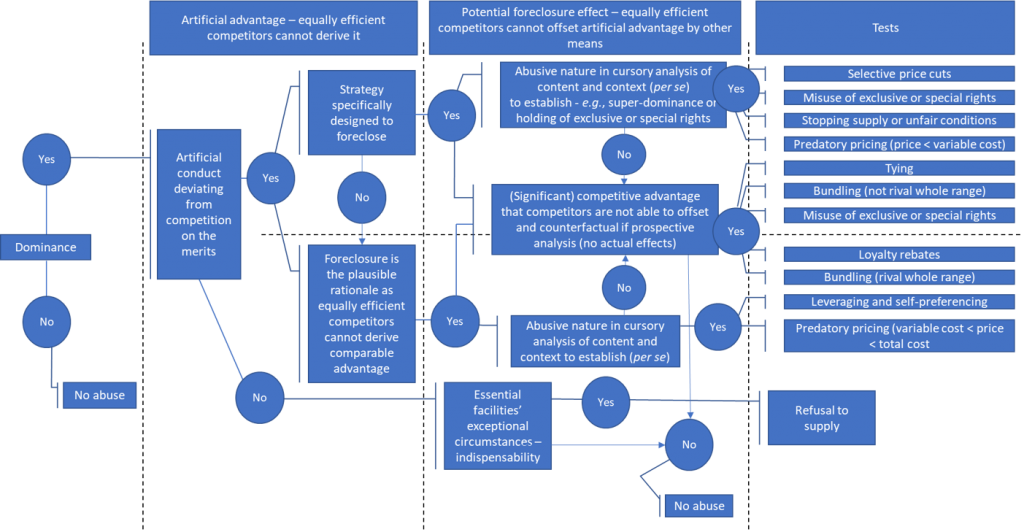
On 31 October, a couple of months before Christmas, I had already sent my Santa letter to the European Commission in response to the public consultation on the Draft Communication from the Commission—Guidelines on the application of Article 102 of the Treaty on the Functioning of the European Union to abusive exclusionary conduct by dominant undertakings (Draft Guidelines)—see full version below.

The Bundeskartellamt (case B6-55/20) has looked into Meta combining data from different services without the free consent required by Regulation 2016/679 (the General Data Protection Regulation, GDPR) and Meta has buried the axe in the wake of Regulation 2022/1925 (the Digital Markets Act, DMA) and its national replicants (like pioneering and bespoke Section 19a of the German competition act).